Posts
Something stuck at the very back of the nose?
- Get link
- X
- Other Apps
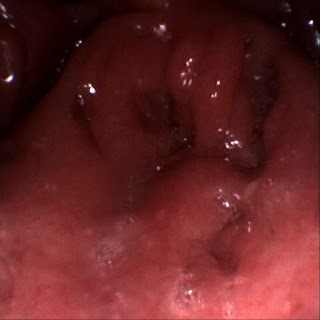
This patient had the sensation of food sticking in the back of her nose when inadvertently coughing or sneezing whilst eating. Initially I was sceptical but when examining from below with the HD endoscope I could clearly see small adenoids that had deep fissures within, where I could easily see food trapping on occasion - see photo. The treatment would probably be a form of adenoidectomy under general anaesthetic.
Tonsil stone deep in a hole in the left tonsil, this is something you do...
- Get link
- X
- Other Apps
Nasal polyps
- Get link
- X
- Other Apps
Nasal polyps are benign swelling of the nose lining. They are basically a severe form of rhinitis, a common problem often due to allergy or infection. They are linked to asthma and often present with loss of sense of smell and taste, plus nose blockage. The case in this photo shows a polyp almost coming out of the front of the nose - quite bad. Treatment is with medical therapy first, including antihistamines, antileukotrienes, steroids, saline washes, depot injections of steroid and as a last resort, surgery.
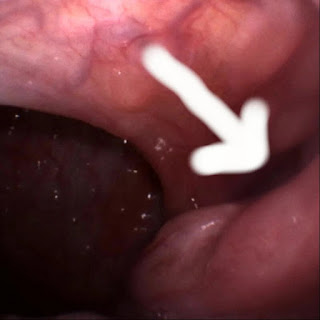
Tonsil stones can form behind the tonsil. See arrow in picture.
- Get link
- X
- Other Apps
Nose Bleeds
- Get link
- X
- Other Apps
Here's a bend in the nasal septal cartilage, also called a deviated nasal septum. It causes disruption to air flow, which leads to drying, scabbing and then new blood vessel formation, which you can see if you look closely. These new blood vessels are not as robust as those originally within the septum, and are prone to rupture, causing nose bleeds, or epistaxis. They can be treated in the clinic with cautery. Longer term a septoplasty will be required to straighten the deviated nasal septum.
Mulberry Turbinate causing postnasal drip and catarrh
- Get link
- X
- Other Apps
Blocked nose due to deviated septum and enlarged inferior turbinate
- Get link
- X
- Other Apps
This patient complained of chronic left nose blockage causing mouth breathing and snoring. Examination showed a septal deviation (left side of picture) and an enlarged left inferior turbinate (right side of picture). Steroid sprays had not helped previously. The patient opted for laser turbinoplasty under local anaesthetic as a lunchtime procedure. Septal surgery in the form of septoplasty may also be required.
Tonsil stone
- Get link
- X
- Other Apps
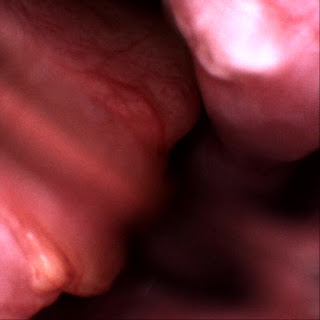
This is a strange one. It looks like a tonsil stone, but it is poking through the back of the soft palate into the post nasal space. So not really that close to the tonsil. Which means some tonsil stones don't arise in the tonsils at all. That's why it's always necessary to have a good look with a high definition scope as in this case.
Very obstructed back of throat causing snoring and sleep apnoea
- Get link
- X
- Other Apps
Snoring and sleep apnoea are caused by blockage of the airway. Here is a picture of the back of the throat where the tonsils are so big they are virtually meeting in the middle of the throat. The whole thing is made worse by a thick and long uvula (the hanging down thing in the back of the mouth). All in all this patient has loud snoring and sleep apnoea and definitely needs intervention in the form of surgery to open up the back of the throat. This will mean laser tonsillectomy and palatoplasty, all under local anaesthetic.
Tonsil stones. Smelly white lumps in the tonsils. Patients don't like them.
- Get link
- X
- Other Apps
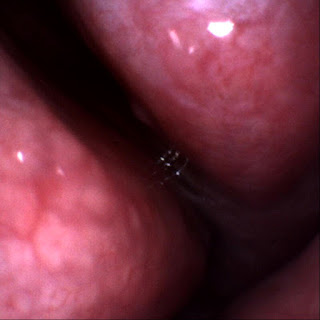
Tonsil stones, or tonsilloliths, are formed when food gets squeezed into cracks or holes in the tonsils during the second phase of swallowing, where quite high pressure form in the back of the mouth, right next to the tonsils. This food, being organic, decays with time, and starts to taste and smell bad. The decaying process can also set up an inflammatory reaction and trigger a sore throat or tonsillitis. This picture shows a crack in the right tonsil (arrow) , zoom in and you'll see greyish round lumps inside the crack. These are tonsil stones.
Lingual Tonsils
- Get link
- X
- Other Apps
The picture below shows enlarged and lumpy lingual tonsils. Lingual means tongue. These tonsils sit on the back of the tongue, above the epiglottis (the pale U shaped structure above the lingual tonsils) and cannot be seen when examining a patient through the mouth. This photo was taken using a high definition digital endoscope at HealthHub. Lingual tonsils often enlarge after removal of the palatine tonsils, which we call tonsillectomy. They may get sore/ infected, like tonsillitis. Your GP will not be able to see them so will not believe your symptoms and wonder if you are making it up.
What it looks like straight after laser tonsillectomy under local anaesthetic spray
- Get link
- X
- Other Apps
This is the right side tonsil bed after laser tonsillectomy under local anaesthetic spray. The majority of the tonsil has been vapourised away. The thin ring of white is the extent of thermal damage caused as heat is transmitted through tissue being vapourised. Usually around half a millimetre. No bleeding has occurred. Bleeding of any sort is very rare.
Incidental tracheal narrowing
- Get link
- X
- Other Apps
 I spotted this today whilst looking for a cause of mild right sided submandibular pain. It's probably unrelated. When I questioned the 31 year old patient he felt he was increasingly short of breath over the laser year but put that down to inactivity during Covid19, and being a bit of a smoker. In fact the picture clearly shows a subglottic narrowing, perhaps 50% of the breathing tube. He may need surgery.
Laser reshaping of nose cartilage
- Get link
- X
- Other Apps
Relatively new laser wavelengths and new technology mean that lasers such as the CO2 and Erbium YAG can be used during nose reshaping (rhinoplasty) surgery when operating on the cartilage at the tip of the nose. These lasers will remove/sculpt, in a way that is more accurate and less traumatic than traditional techniques. A simple experiment on cartilage showed that 5 Watts of superpulse CO2 laser power with a 0.015mm spot size gave a clean predictable cut. When used with a Computerised pattern generator and a 2mm spot diameter with a 1 msec dwell time, this gives very nice sculpting and cartilage removal effect. This picture shows one of the initial studies.
1:748 laser tonsils bleed
- Get link
- X
- Other Apps
We have performed many laser tonsillectomies using local anaesthetic spray for numbness. Today, number 748 bled a little. I found an area where #tonsilstones were forming in the top of the tonsil. I went too deep in my eagerness to completely remove the involved tissue, and probably hit a small branch of the superior tonsil artery. After bipolar diathermy, Lignospan injection and topical adrenaline the patient stopped bleeding and subsequently went home. It just shows you have to be prepared and test your emergency kit regularly, ready for that 1:750 case.